


Scaling Data Center Skid Fabrication with Dual-Robot Welding
The Inrotech-MicroTwin® brings a highly automated approach to automated skid welding, built around two welding robots operating on the same rail-based gantry. The dual-robot configuration is designed to increase welding capacity while making better use of production space, equipment and skilled labor.
As demand from AI and hyperscale data centers increases, fabricators need to scale production without simply multiplying welding stations and operators. This is where the dual-robot concept provides several important advantages.

Mutiple working zones
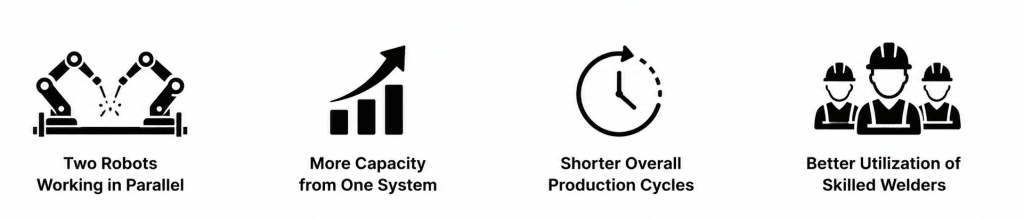
Two Robots Working in Parallel
The most direct benefit is the ability to perform welding tasks with two robots within the same production system. Welding work can be distributed between the robots, allowing more welds to be completed during the same production cycle.
Another advantage of the MicroTwin configuration is the ability to handle multiple working zones within the same system. The two robots can be assigned to different areas of a skid or structure, allowing welding activities to be distributed across separate zones instead of relying on a single robot working through the entire structure sequentially. For skid structures containing many welds, this parallel capacity can significantly improve throughput compared with relying on a single welding robot with a single working zone.
Increase Capacity
More Capacity from One System
Adding welding capacity traditionally means adding another manual station or another complete robotic cell. MicroTwin integrates two robots into one gantry, one working area and one control system.
This means manufacturers can increase robotic welding capacity without duplicating the entire automation setup. Both robots share the same overall production infrastructure while providing additional welding capacity. For manufacturers where factory space is valuable, this provides a more efficient way of increasing output within the available production footprint.
Higher Throughput
Shorter Overall Production Cycles
The advantage of two robots is not limited to welding speed. On structures with multiple suitable welds, the workload can be divided between the robots instead of being completed sequentially by one robot. This can reduce the time a structure occupies the automated welding area and allow the next skid to enter sooner. Higher throughput can therefore come from shortening the complete welding cycle, rather than simply making an individual weld faster.
Better Utilization of Skilled Welders
Two automated robots can take over a larger amount of repetitive welding within each production cycle. This changes the role of skilled personnel from performing every weld manually toward preparation, supervision, quality control and more complex welding tasks. As production volumes increase, this becomes particularly valuable because additional welding capacity does not necessarily require welding labor to increase at the same rate. For data center fabricators, the dual-robot concept ultimately provides a different way to approach increasing demand.
Inrotech-MicroTwin® builds on years of experience with Inrotech-SensLogic® and automated panel welding. This accumulated knowledge of profiles, joints and welding routines can be leveraged to create a library of reusable routines for skid fabrication — helping standardize welding processes and efficiently reuse proven routines across similar structures.